Thu 1 May 2008 - The man who knew too much

Perhaps sometimes it’s a disadvantage knowing too much about all the transport options. When mild interruptions occur, it might make one more inclined to take the alternatives, even when ultimately it doesn’t really save any time.

Take, for example, Tuesday morning’s commute.

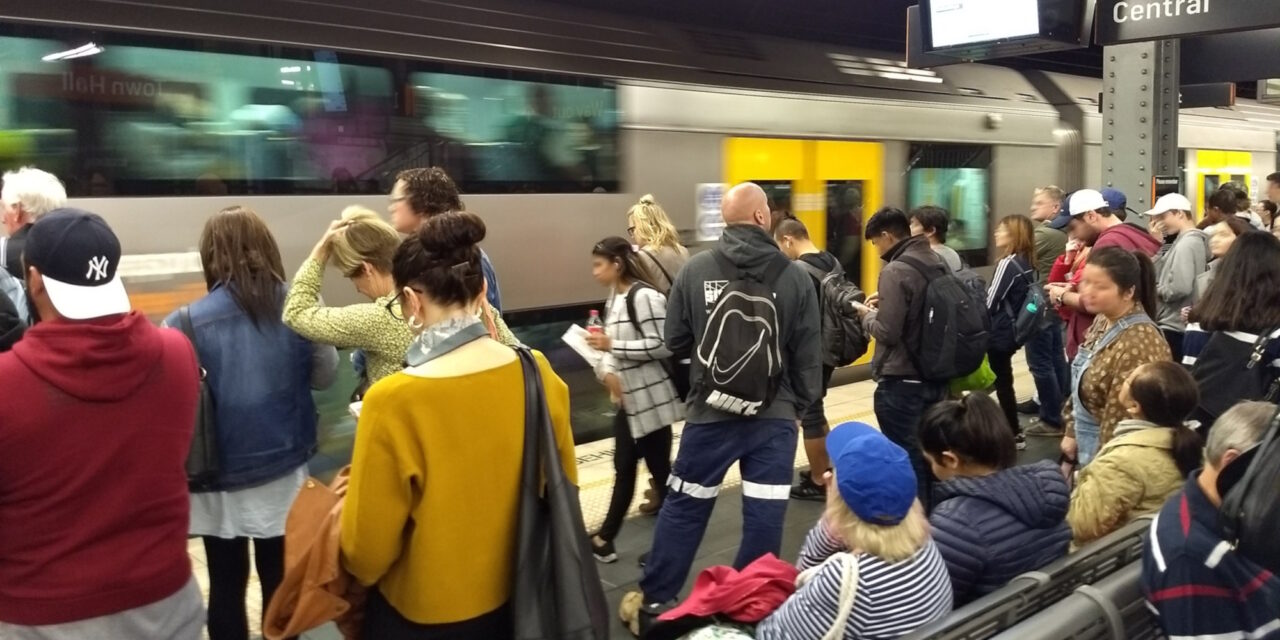
It started with two SMSs. The 8:36 and the 8:52 from Glenhuntly to the city, both cancelled. Two in a row means the following couple, the 9:01 and 9:13, would be crowded. (In theory they might stop some expresses to fill the gaps, but this doesn’t always happen).

So I decided after the school run to drive to Carnegie instead. Good ol’ dependable Dandenong line (!).

8:45am. Roadworks behind the library, so had to go a slightly different way, and I noticed where I sometimes used to park is now 2 hour parking, so I ended up a bit further from the station than planned. But no bother.

Walk to the station and… the host lady is saying there’s a problem. A car collided with a train on the crossing at Murrumbeena. And that was compounding an earlier delay with a sick passenger. “It’ll be at least half an hour. I’m really sorry”, she said. And while once a disgruntled passenger might have shot the messenger and cursed her and the rest of Connex and the powers that be, instead I heard one tell her “it’s okay, it’s not your fault.” Maybe instead they were silently cursing the car driver involved.

I didn’t feel like traipsing back to my car, so I walked to the nearby 900 bus stop, to catch it to Caulfield.

8:52am. My eyes narrowed as I got to the stop. The automated Smartbus sign claimed that the 8:57 and the 9:12 buses were both expected in 30 minutes. These signs aren’t known for their accuracy, but given the number of people already waiting, I pondered for a minute what I should do next. After a minute or two the sign was still claiming 30 minutes.

I decided to keep walking. It’s not that far to Caulfield anyway, and I was betting that because of the train disruptions, causing localised traffic problems around crossings, as well as heavy passenger loads, the buses might indeed be 30 minutes away, and might be so crowded when they arrived that nobody could board.

Someday someone in authority will dictate that all urban roads need to have proper footpaths. Until then, there are spots like on Dandenong Road between Carnegie and Caulfield where it’s just grass on one side. And they call this the 21st century. But no matter — what was more of a concern was that as I walked, I began to see city-bound trains passing me. D’oh! I should have waited at Carnegie.

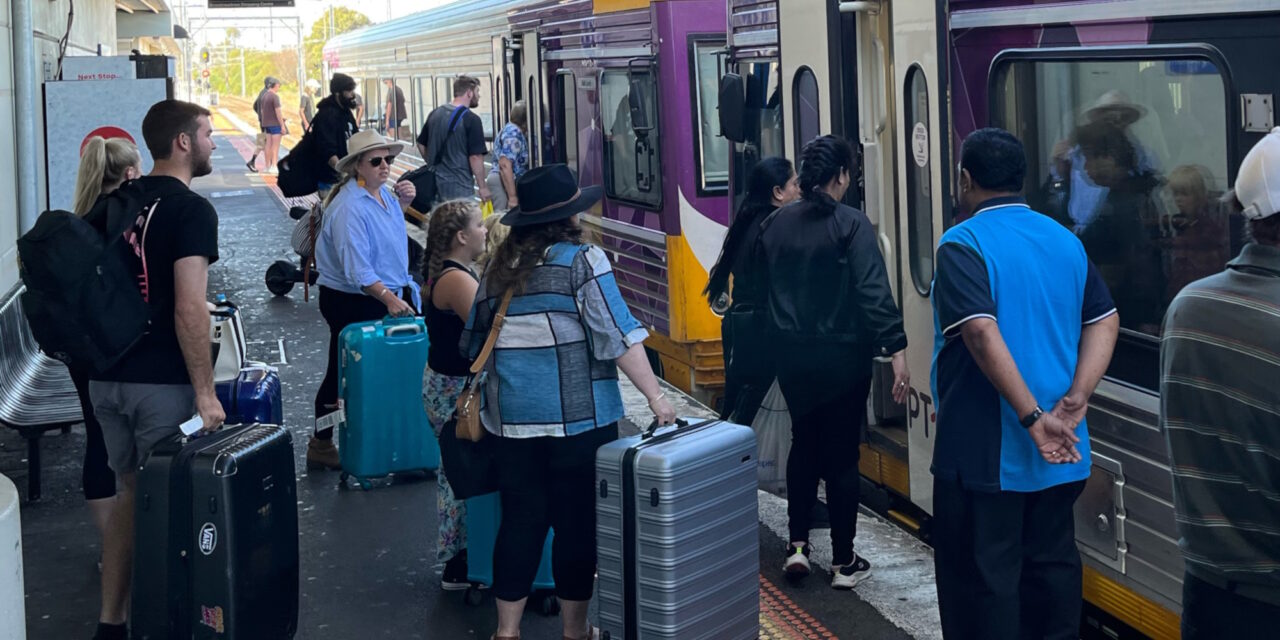
9:05am. It took less than 15 minutes to get to Caulfield. Up on platform 3, a stopper was arriving. Packed. I could see the sign on platform 1, claiming an express was two minutes away, so I jogged down the ramp to switch platforms. And because the day had been going so well, you can guess what happened next, right? Yep. Train Controller Murphy switched the express from platform 1 to platform 3. Seriously, this kind of stuff is like nothing else for getting people onto the roads.

A bunch of us jogged back to platform 3, and got onto the train, which was, at least, express, overtaking the earlier packed stopped along the way.

From there it was smooth sailing. I decided not to change onto a Flinders St direct train — on days like this it’s better to stick with the one you’re on, which is confirmed to be actually getting somewhere. Was at Parliament by about 9:30, just a walk down the hill to work.

I can’t help thinking it would have all been easier if I’d just done the usual plan and gone to my usual station in the first place. But hey, at least I got some extra exercise.

And remember: we’ve only still got level crossings like the Murrumbeena because the programme to get rid of them all was cancelled in the 70s to pay for freeways instead.

Wed 30 April 2008 - Cabbies protest

It was easy to find a taxi this morning in the city, but more difficult to find a driver — or at least one who would take you anywhere.

Cabs in Swanston Street Blockade of Flinders and Swanston Streets

Taxi drivers were protesting about driver safety, blocking the intersection of Flinders and Swanston Streets. Quite a few empty cabs were parked nearby.

Despite claims of massive traffic disruption, most people seemed to be working around it okay. The trams have a fairly-well established plan for this kind of thing. Buses too would have been diverted. The trains weren’t affected — in fact it made it easier to get out of the station and across the street.

Cars? Who cares. Only a minority of people drive into the city anyway, and usually it’s cars blocking other cars. Not that that stopped the radio traffic people from moaning about it.

Fair enough that the cabbies should protest. Everyone has a right to feel safe at work. Tram drivers have metal cages to lock them away. So do many bus drivers. The transparent protective screens proposed (and already used in Sydney and other cities) seem a good idea. And if my memory serves me correctly, the authorities have been talking about this for a decade or more.

In the end it seems the government has seen sense, with safety screens to be fitted, and other measures to be taken. By 2pm the blockade was disbanding. When I went past at 2:30, all the leaflets had been picked up, and it was like it had never happened.

(If you’re wondering, the PTUA does not normally get involved in taxi-related issues.)

Tue 29 April 2008 - Revving up the rev heads

The Age yesterday ran a report on the PTUA’s submission to the Garnaut inquiry on climate change, with the headline being “Ban new freeways: transport group” — above another rather good article about cars not being on average any more efficient than 40 years ago.

It didn’t take long for the rev heads to spot the report, and as you might expect, they launched (within their own little forum) a tirade of abuse: everything from tree hugging, whale saving, dread locked morons to mungbean chewers and tree huggers. It was pretty clear none of them had read the Age article or the original press release, let alone the study itself.

Green groups (real greenies, that is, not just us sustainable transport advocates) also spotted the Age report, and a version of the story got a run in the West Australian. And there was a chat between yours truly and John Barron this morning on ABC News Radio. (MP3, 9Mb, 4 min 53 sec)

Perhaps to some people it sounds counter-intuitive: that building motorways doesn’t solve traffic congestion, but makes it worse. But not if you think about it. When each new road opens, people consider their travel options, and if it’s markedly easier to drive, many of them do. They drive longer, and in greater numbers, because they can, and the new road fills up. The end result is we have more space dedicated to roads, more cars on the road for longer, and more congestion and pollution.

Maybe we should turn it around: What proof is there that building motorways does help congestion? The quick answer is that there’s nowhere in the world (except perhaps Houston, where they spend billions on it every year, and oh, look at their greenhouse emissions!) where this has turned out to be the case.

The French have worked all this out, and last October President Nicolas Sarkozy pledged to stop building motorways and put the money into railways instead, to improve freight and passenger rail.

Anyway, this is only a small part of the report. What the rest of it is pointing out is that while transport isn’t the majority of greenhouse emissions, it is growing fast (up 30% in the last 15 years) and as part of an overall push to reduce emissions, action needs to be taken on transport. Hybrid cars will only help to a certain extent (and actually rely on stop-start congestion to be efficient), oil is running out, and other fuels are unproven (with biofuels in particular causing emissions during production, and resulting in food shortages).

Good to have sparked some debate about it, anyway.

Mon 28 April 2008 - Lines? What lines?

Lines? What lines?
Car parked across lines
(Outside Officeworks, Highett)

No time to park properly! Emergency stove purchase!
Car parked halfway in disabled spot
(Outside Clive Peeters, Braybrook)

Thu 24 April 2008 - Things I didn’t know about ANZAC Day

Tomorrow is ANZAC Day. Obviously up until now I haven’t really been paying attention, because this week I’ve read things I didn’t know about it until now:

  • Four days before ANZAC Day 1918, Manfred von Richthofen, aka The Red Baron, was shot down over France, probably by Australian anti-aircraft gunners. (Thanks Jayne)
  • On ANZAC Day 1918 (following an offensive launched the night before), the town of Villers-Bretonneux, France was liberated by the ANZACs. According to one report, the town is now affectionately known by Australians as “VB”.
  • Birdwood Avenue, in front of the Shrine of Remembrance in Melbourne, is named after William Birdwood, who was first commander of the ANZACs — though he apparently didn’t visit Australia until after the war had ended.

It would seem that there’s always something new to learn about days gone past. And that the knowledge of what our forebears fought achieved will continue on. Lest we forget.

Thu 24 April 2008 - Brushing teeth

Went to the dentist last weekend for the not-quite-six-monthly-more-like-nine-monthly checkup. They reckoned my brushing is going well. I didn’t tell him I only floss every couple of weeks…

I brush my teeth two or three times a day. When the kids are around, it’s the latter, as I brush with them at their bedtime, then again when it’s my bedtime.

Some swear by their electric toothbrushes. I’m happy to stick with analogue. In the past I’ve been told off for not giving the gums enough attention, but that seems to be okay now.

Dunno if I’m taking the best care of my teeth that I possibly could, but if the dentist is happy, then so am I.

Wed 23 April 2008 - DIY checkouts

Safeway and Coles are going to put self-serve checkouts into their supermarkets, starting with newly refurbished locations.

I’ve used these for a couple of years at Big W at Southland and QV. You scan each item, then put it in a bag in a tray of the checkout, and it appears to weigh the items to make sure what you’re putting in the bag matches what you’ve scanned. Then you pay using the usual methods, with a staff member having to come over if a credit card signature needs to be sighted.

You also need to pay attention and ask for help if the item you’re buying has a physical security tag on it. I once made it all the way home with a tag on some clothing (I don’t remember if it made the alarms go off — I guess not), and had to take it back in to get it removed. Magnetic (or they might be RFID) tags get automagically disarmed.

There are about 8 auto checkouts, usually with 1-2 staff on duty, so I suppose it saves the company money overall.

I wouldn’t assume the weighing is foolproof, but I suppose with staff (and presumably cameras) there’s a disincentive to try and trick the machine to make off with more than you paid for.

It works quite well for Big W, especially when you’re only buying a few items and the queues-served-by-humans are long. Dunno about supermarkets though — if you’re doing the week’s Big Shop, having a professional weigh and scan and pack all your items would have to be faster, wouldn’t it?

I wonder what happens if an item won’t scan? Do you get to reach for the PA and yell “Price check!”?

Tue 22 April 2008 - Radio traffic news

I know 774’s traffic and train updates are done directly in the studio (I saw it happen when I was in there the other week). Channel 10’s are done from a helicopter — you get to see the lady in it as she talks.

What about the other radio stations? Many of them make it sound like someone’s on a mobile phone somewhere, but do they really go to the expense of having someone out there in a chopper (which would only let them see a portion of the traffic), or is it just someone on a phone from an office somewhere reading off the VicRoads TrafficInfo web site?