My rights as a pedestrian

Wed 1 July 2009 7:12am by Daniel · Filed under: Morons on the road, Transport 

When I’m out walking, I actively (but not foolishly, I hope) defend my rights as a pedestrian. If I have an opportunity to walk safely and legally before a car goes, I will take it.

The main rules are not difficult to comprehend, but some motorists just don’t seem to understand them.

[Page references are those in the Vicroads PDF summary of the road rules.]

Red means stop. It doesn’t mean drivers can zoom through at the last minute. Given that Yellow actually means “stop if it is safe to do so” [p27], there’s no reason why drivers should still be travelling through the intersection after I’ve got a (conflicting) green man. Not that there’s much I can do about this but glare.

Drivers are meant to stop behind the stop line, not halfway across it blocking the pedestrian crossing. If blocked by the cars ahead, that’s the driver’s fault for not looking ahead to make sure it was clear. [p27]

The zebra crossing means vehicles have to give way for me to cross. If a motorist was driving so fast they had to brake sharply, that’s their fault [p58]. (I view extended periods of delays to motorists at busy zebra crossings, such as in Flinders Lane, with some glee. If they were stupid enough to bring their car into the middle of a big busy city, they’re going to face some delays in their quest to get to the next red light.)

Flinders Lane pedestrian crossing

Flagged Children’s Crossings are more strict. Vehicles have to stop if someone is waiting to cross, and not drive through until the last person is completely off the crossing. [p57] (I also recommend not trying to run down crossing supervisors at lighted intersections, such as some right-turners at McKinnon and Jasper Roads seem to do.)

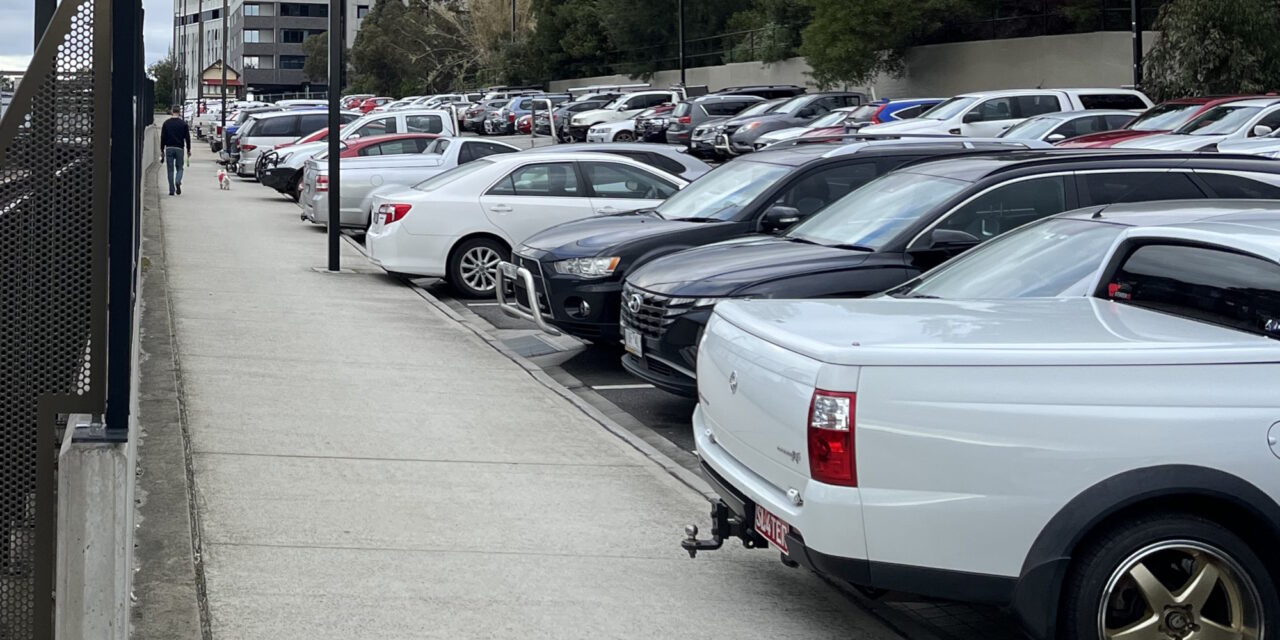
Vehicles are not allowed to park on a footpath.[p78] Foot. Path. It’s really not that hard.

If a driver is turning across my path, they have to give way to me [p29] — unless it’s a roundabout.

Many motorists, myself included, give way when coming out of side-streets to crossing pedestrians. Strictly speaking vehicles don’t have to do this, but personally I consider it polite. Update: Commenter Andrew notes elsewhere the rules say: “At Stop or Give Way signs [...] you must not only give way to vehicles, but also to any pedestrians at or near the sign [...]”

If a vehicle is going into or coming out of a driveway or carpark or whatever, they have to give way to me. [p60]

Drivers have to stop for tram passengers unless there’s a safety zone/platform stop. [p60] The tram is a big thing on wheels that’s 3-5 times as big as a car; there’s no excuse for not seeing it.

I don’t have to cross at the lights if they’re more than 20 metres away (but I’ll certainly do so if it’s safer to do so).

The above rules are, I think, pretty logical.

But there are some others I learnt about while reading up on it, which I suspect not so many people are aware of.

  • Motorists have to give way to peds when turning in a slip lane (including separated from the other lanes by just a painted island) [p30]
  • Motorists have to give way to all peds (and everyone else for that matter) when making a U-turn [p31]
  • Giving way to peds when turning includes instances such as turning into a main road that the pedestrian is crossing. [figure 24, p35]

Footnote: Why have VicRoads published the road rules in a PDF that doesn’t allow you to copy text out of it?

Something for your Pod

Mon 29 June 2009 7:57am by Daniel · Filed under: PTUA, Transport 

I don’t have a post for you this morning, so here’s something I prepared earlier.

This morning I had a chat to the people at 3CR about PT issues, and it reminded me of this recording from Joy FM back in April. I think they’d been intending to post the podcast themselves, but haven’t… so I’ll do it myself.

There’s a couple of spots where it seems to skip very slightly (though nothing that really causes an issue listening) — sorry about that, it was recorded off a slightly dodgy stream. When recording it I rabbited on and on… they’ve chopped it down to just over 8 minutes.

By the way, to clarify on the anecdote of Frank Casey, he wasn’t a disruptive passenger — he got cranky because the train he was on was said to be out of service and terminated, then once all the passengers had alighted, it left and continued on its journey, empty.

Hope it’s not too boring — happy listening!

Connex and Yarra Trams dumped

Fri 26 June 2009 7:26am by Daniel · Filed under: PTUA, Transport 

So, both Connex and TransdevTSL (operating as Yarra Trams) are being shown into the departure lounge, with MTM (MTR) and Keolis to replace them.

I don’t think the former is a surprise, though the latter is.

Some are celebrating. I know this for a fact, as yesterday morning at the station I heard one man say to his wife that he’d be opening a bottle of champagne if Connex got dumped.

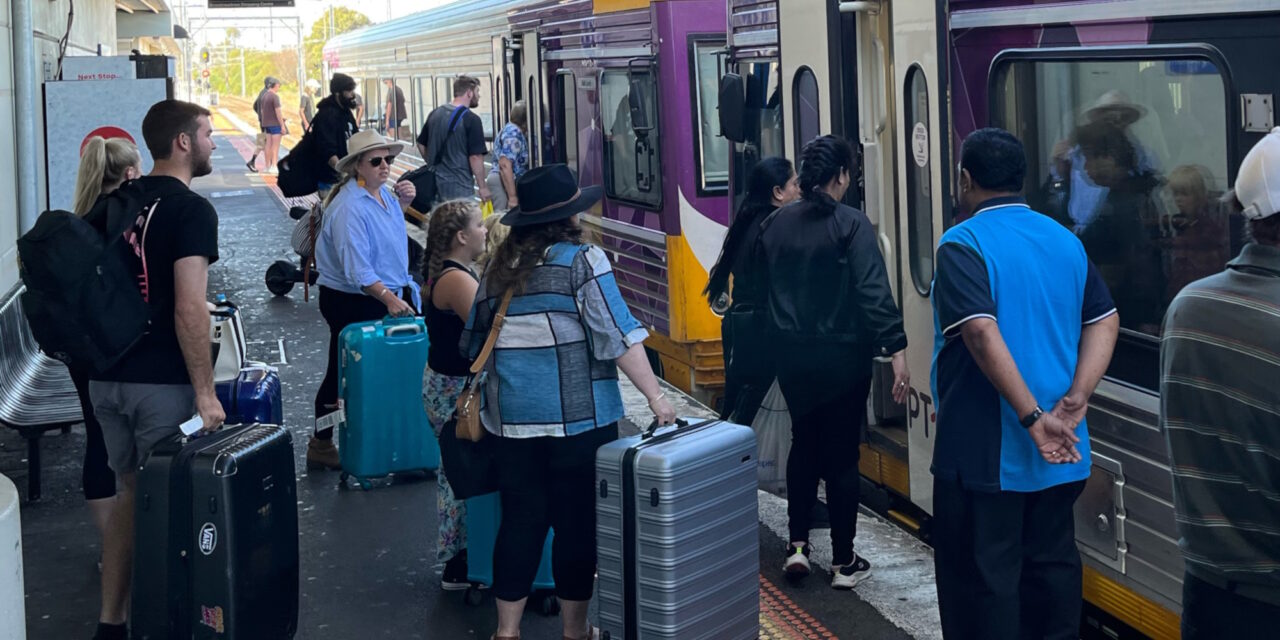
Just another crowded train
(Note the newspaper advert!)

But how much will really change? If it’s the same old dodgy infrastructure (tracks that buckle in summer, signalling that fails, trains with unreliable air-conditioning, a lack of tram on-road priority), the new companies will face much the same issues. Just because MTR runs a great system in Hong Kong doesn’t mean they can magically do it here.

And who’s taking responsibility for planning the greater PT network? You know the sort of thing, actually ensuring that buses, trams and trains are timetabled to meet properly at interchange points, rather than the un-coordinated mess we have now? Like the infrastructure, that should be a role that sits with government, not the individual operating companies.

That said, there are things the operators can do to improve things: better cleanliness and maintenance, more staff, better handling of disruptions.

It’ll be interesting to see how they go.

PS. Lunchtime: Audio of Mr Brumby fluffing the announcement, accidentally saying Keolis would run the trains. (MP3, 27 seconds, 218Kb)

Who will it be?

Thu 25 June 2009 7:02am by Daniel · Filed under: Transport 

The big announcement may well come in the next few days: who will take over running Melbourne’s trams and trains from November?

Anybody want to put their predictions on the table? Leave a comment! Your choices:

  • Trains: Connex (Veolia, incumbent) or MTM (Hong Kong MTR consortium) or Keolis
  • Trams: Yarra Trams (TransdevTSL, incumbent) or Keolis

(I had a Google survey thing here for a short time, but it was too clunky, sorry.)

I think the thing to bear in mind is that none of it will make much difference unless the government commits to fixing the infrastructure and fleet problems that cause most of the issues. If all we get is another logo, little will really change.

That said, there is scope for the operators to run things better: put on more staff, voluntarily run more frequent services (at least outside peak hours, when trains are available), lobby more strongly for infrastructure improvement, better maintenance and security (eg around fleet depots and stations, where vandalism occurs).

Dream machine

Wed 24 June 2009 7:19am by Daniel · Filed under: Dreams, Driving 

The other week, in one night, I had a trio of ridiculous dreams. So ridiculous that you half know it’s a dream, and it’s a ridiculous situation, but you keep on dreaming it anyway.

I’ve forgotten the first.

In the second, someone was knocking at my front door and trying to look through the frosted glass while waiting to be let-in, and I, then undressed and taking cover at the corner, kept calling out “Who is it?”, but they wouldn’t answer. You can’t actually see anything more than abstract shapes through my front door anyway. Ridiculous.

And in the third dream, my car (which has worked perfectly in the almost-year I’ve had it except for an electric window going kaputsky — ch-ching!) was behaving really sluggishly, and accelerating ludicrously slowly, especially up hills. Ridiculous.

Then last week in real life it started happening. On cold days, 5 degrees and below. Stalling. Shuddering. Sluggish. Blah.

See, life is full of gambles. I gambled my money away when I bought the car. I’ve gambled that it’s worth trekking across town to the dealer I bought it from every six months to keep the warranty up-to-date. Even though it seems like the warranty is worded in such a way that there are so many exceptions that they might never be liable for any repair costs.

So yesterday morning I woke at sparrow’s fart and headed out the door just after 7am, which is normally about the time I’m getting up, in a failed attempt to beat the traffic. At least I may have beat some of it; it took about 45 minutes to get to the dealer. I’m glad I normally avoid driving in rush hour.

Dropped it off for the six month checkup and so they could look at the stalling/shuddering.

The verdict? A bill of $245, of course — and that included no charge for the fault. On the one hand, just part of the exorbitant cost of personal motorised transport; on the other, quite low for a visit to the car dealer for a service.

According to the receipt (which is mostly made up of the usual mechanic gibberish) they checked the car’s computer history for misfires. Yes, apparently this humble 9-year-old Astra has a black box recorder. Apparently it gave them enough information to tweak things.

Just hope it worked. I hate those early mornings.

PS. Lunchtime: Rae has a rant about her drive to work.

Phoenix changing

Mon 22 June 2009 7:12am by Daniel · Filed under: Transport 

When I visited Phoenix, Arizona in 1996, it appeared to be the archetypal car-dominated city. I was told pretty much the only PT was buses once an hour. The freeways were packed at rush hour. Nobody walked anywhere.

The downtown area was (especially on weekends) so deserted that they had to have signs saying “Welcome to downtown Phoenix” so that you knew you were downtown.

While the people were friendly, it was exactly the type of city I’d hate to live in.

But it looks like it’s changing: they’re getting a lot more medium-density and mixed-use development, and… trams.

A new tram/light-rail line, 20 miles long. Quite impressive. Having spent all that money on infrastructure, they didn’t skimp on the services, either — every 10 mins weekdays, 15 weekends, 20 evenings.

Obviously it’s only one route, but apparently already they’ve got more patronage than expected, and are looking at more lines.

Nice to see even the most car-dominated cities are starting to move in the right direction.

(via Treehugger)

How to move people efficiently

Fri 19 June 2009 7:36am by Daniel · Filed under: Melbourne, Transport 

The most efficient way of moving people is using their own two feet.

Here’s the statistical measure:

Square metres per person
(Graph from Teufel, D, 1989, ‘Die Zukunft des Autoverkehrs’ (The future of car traffic), Umwelt und Prognose Institut, Heidelberg — and used more recently in PTUA’s Response to Australia’s Future Tax System Consultation Paper. Here’s another representation of similar information.)

…and here’s a practical example:


Don’t bother with the sound, it’s crap due to some noisy machinery nearby. Sorry, it’s a bit jerky. Gimme a break, it came straight off the phone onto Youtube. Need to figure out how to fix that.

Anyway, you get the idea, right? The pedestrian sequence here shifts an order of magnitude more people than go through in cars each hour.

What do you call these intersections that allow people to move in any direction? It’s not a zebra crossing, nor a puffin, pelican or toucan… ah, found it — apparently it’s known as a pedestrian scramble. Not as catchy without an animal name.

Anyway, I do wonder why there aren’t more of them. As far as I know this is the only one in Melbourne, but other locations would really benefit, with Bourke/Spencer Streets being a prime candidate.

Elsewhere, these might not work, but there’s a lot more than can be done to improve pedestrian amenity and get more people walking.

Making tracks

Mon 15 June 2009 8:15pm by Daniel · Filed under: Transport 

Making tracksWhy does Australia have problems with multiple rail gauges?

In summary, it seems to have gone like this:

  • 1848: Everyone agreed to use standard gauge (4 ft 8.5 in).
  • 1851: The Sydney Railway Company had a chief engineer who preferred broad gauge (5 ft 3 in), and convinced everyone to switch to that.
  • 1854: The first line opens in Melbourne, to Sandridge (Port Melbourne), using broad gauge, as agreed.
  • 1855: The Sydney Railway Company gets a new chief engineer, who lobbies against broad gauge, and convinces the NSW government to change its mind, and they open their first railway using standard gauge.
  • 1856: South Australia opens their first line, using broad gauge.

And the mess went forward from there at the dizzying pace of the 1800s railway industry. By 1883, the Victorian broad gauge and NSW standard gauge lines met near the border at Albury. Meanwhile Queensland had gone with narrow gauge (3 ft 6 in), and met their NSW cousins at the border in 1888. WA also used narrow gauge, as did Tasmania and parts of SA.

(More detail and sources in Wikipedia.)

There was a break-of-gauge at Albury until 1962 when the new standard gauge line to Melbourne opened. Subsequently the Melbourne to Adelaide train the Overland shifted to standard gauge in 1995 when the Keating government standardised that line, mostly for the benefit of freight (under a project called “One Nation”!).

In the near future the V/Line trains to Albury will also switch to standard gauge. For now the other Seymour services through to Shepparton will remain on the present broad gauge line, though I wouldn’t be too surprised if they switch before too long. The Seymour line was the only one that didn’t get an infrastructure upgrade as part of the Regional Fast Rail project.

So, with the trend now towards standard gauge, wouldn’t it make sense to eventually convert everything, particularly the regional lines, to assist interstate rail freight in particular? And also to allow eventual high-speed interstate rail to use some existing tracks? Not necessarily as a priority of course, but eventually?

Probably. Which is why it’s puzzling that for the Regional Fast Rail project, they didn’t use gauge convertible sleepers. The sleepers can have extra holes added to aid conversion later for minimal cost. Given concrete sleepers can last 50-60-70 years, it would have made sense.

Neither are they doing so as they lay concrete sleepers on the suburban network. Sure, it’s not important right now, but why lock out the option for three generations?

Perhaps the lack of forward planning that got us into this mess in the first place is still around?

Next page »